

News
Spotlight on | Sinagot and their Friends
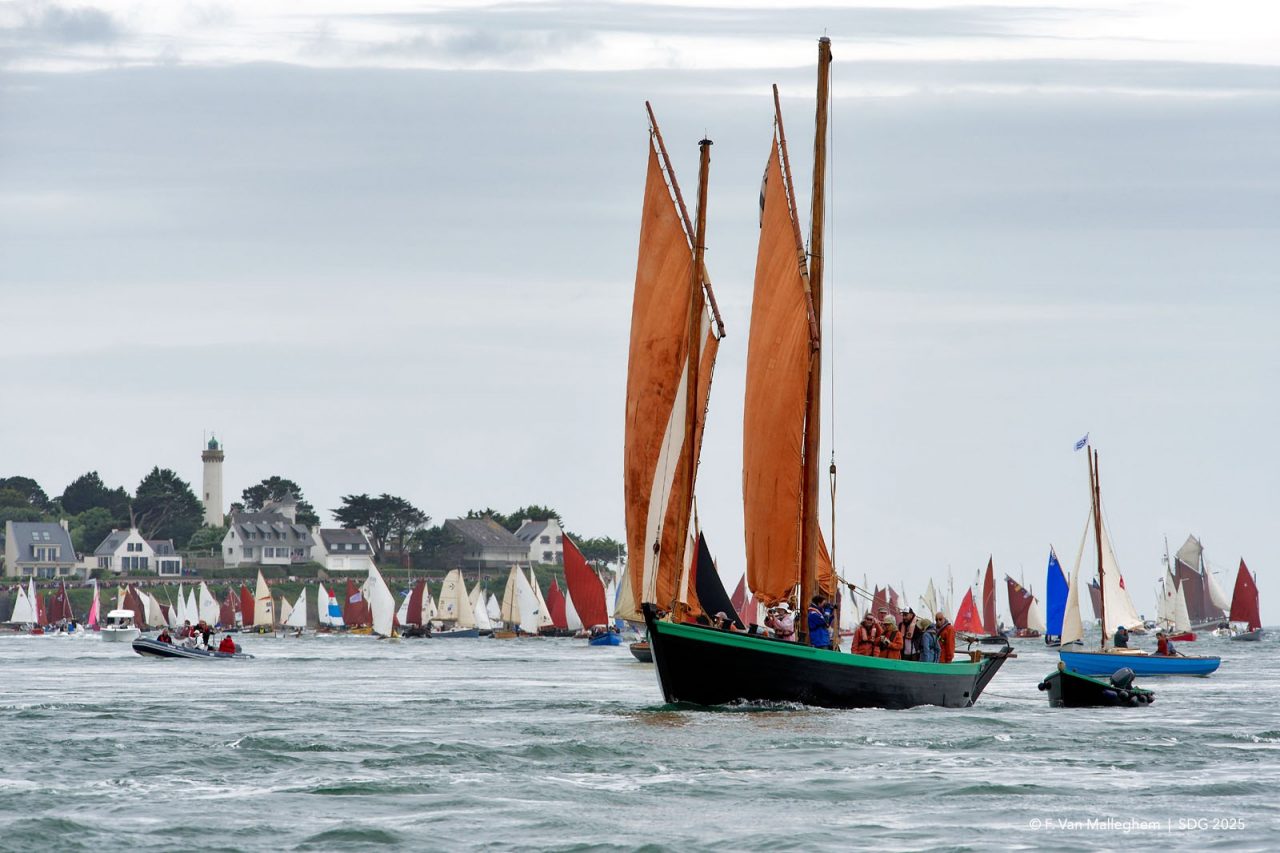
The launch of a boat is always a memorable moment… In mid-May, following a major restoration project, the Sinagot ‘Mab er Guip’ returned to its favourite playground: the treacherous waters of the Gulf of Morbihan. This event was celebrated in style with a wonderful trip out to sea organised for everyone who had worked on the boat. Tradition never fails to be a festive affair. A few weeks earlier, it was the ‘Joli Vent’ that had left the shipyard to kick off its season of sea trips and festivals. Meanwhile, ‘Les 3 frères’, the third boat in the Amis du Sinagot fleet, restored two years ago, was already up and running.
Welcome behind the scenes of this association, which brings together around a thousand members each year, sharing and passing on ancestral know-how, a passion for sailing and a collective sense of fun centred around a boat that is emblematic of the Gulf: the Sinagot.
“Our boats require very regular maintenance; we restore them one by one, so as to stagger the restoration work. Exceptionally, this winter we had to organise a double restoration project for ‘Joli Vent’ and ‘Mab er Guip’: there was a huge mobilisation of our members!”
When you love something, you preserve it.Les Amis du Sinagots own half of the Sinagot* fleet, and one of them, ‘Les 3 Frères’, listed as a Historic Monument, is the last to have been built for fishing: a living symbol of the history of the Gulf of Morbihan.
A fishing boat and more
Originally, the Sinagots had indeed been designed for dredging wild oyster beds, shrimp fishing or trawling. They were also ‘utility’ boats, used to transport people and goods throughout the Gulf.
Their shallow draught and manoeuvrability made them indispensable: 150 Sinagots criss-crossed the Petite Mer in the 19th century and well into the 1920s.
With shellfish farming taking centre stage at the next edition of Gulf Week, the Sinagots will once again be in the spotlight this year.
Precision, an eye for detail and a steady handThe associations safeguarding these iconic Gulf boats therefore play a crucial role. The essential restoration projects provide opportunities to pass on ancestral skills: woodworking and boat maintenance. All this is done by hand, collectively, using basic tools, ‘in a spirit of sharing and good humour’, adds Daniel Fresneau.
At each restoration project, members who wish to do so are invited to strip the boats down to their bare frames and take part in the labour-intensive stages (underwater caulking, mast construction, etc.). Everything relating to the structure of the Sinagots is entrusted to professionals**. The volunteers then take over to ‘spruce up’ these precious hulls: painting, applying wood sealer, etc.
This training in woodworking and the maintenance of traditional boats continues throughout the shipyard projects
We’re sowing the seeds…
Thanks to their motto, ‘If you come along, you’re in’ (get it? J), the association has around 1,000 members by the end of each season: ‘We organise discovery outings – there were nearly 300 last year, and every time, there were plenty of smiles at the finish! ”
Meanwhile, around a hundred volunteers meet up every month, united by a shared enjoyment: “There are lots of pensioners, but we’ve noticed a recent surge in interest from people in their forties: they come for the beauty of the boat, the playing field and the association’s dynamism. We also tailor some of our outings towards young people facing difficulties: we’re sowing seeds that we may one day reap…”
For those who prefer reading to sailing, the Friends of the Sinagot have compiled 100,000 documents on the history of this unique rowing boat.
In short, without the Sinagots, the Gulf would not be the Gulf of Morbihan, and without the maintenance and preservation work carried out by these invaluable associations, the Sinagots would no longer exist.
The Gulf needs them, and they need everyone’s support. “This is a wake-up call; we are heading into very difficult times***.”
* The 6 Sinagots of the Gulf‘Les 3 Frères’, listed as a Historic Monument in 1983 and built for fishing in 1943.
‘Joli Vent’, one of the first Sinagots built for pleasure cruising, in 1958.
‘Mab er Guip’, or ‘Fils du Guip’, built in 1985 for pleasure cruising.
‘Jean et Jeanne’, built in 1988, based in Séné.
‘Crialeïs’, built in 1990, based on the Île aux Moines.
‘Ma Préférée’, built in 1981, currently being restored by the Vieilles Voiles de Rhuys association.
** The Guip shipyard, which has built numerous Sinagots, is regularly called upon for restoration projects. This year, the Friends of the Sinagot turned to the Bascatic shipyard, located in Baden. “They all do a remarkable job, with exceptional precision, all carried out to the highest standards using the same techniques and tools as in the past,” comments Daniel Fresneau.
*** Cost of restoration work2025, Les 3 Frères: €170,000
2026, Joli Vent: €15,000 – Mab er Guip: €155,000
2028, Joli Vent: €60,000 to €90,000 (estimated)
- Published on 26/06/2026