News
The Gulf of Morbihan Regional Nature Park: A Valuable Support Mission
Morbihan Gulf Week has been working with the Regional Nature Park since its creation in 2014 (and even before that, through the organization that preceded the Regional Nature Park, which was already a Natura 2000 operator), as well as with all of the event’s partner municipalities.
The 19 municipalities involved in the Gulf of Morbihan Week festivities are, in fact, part of the two Natura 2000* sites managed by the Regional Nature Park and the Gulf of Morbihan.
In short, within this natural setting that is the Gulf of Morbihan, every public event must be submitted for approval to the Ministry of the Environment via a “Natura 2000” application. For an event on the scale of Gulf Week, this type of application is at least a hundred pages long...
Valuable AdviceThis essential process is carried out with the help of a consulting firm and the support of the Regional Nature Park’s teams. Their role is to provide audits and advice on these administrative procedures as well as on implementing measures to protect local flora and fauna.
“We have been tasked by the government with assisting event organizers with their Natura 2000 compliance efforts and ensuring they can obtain their approval so as to minimize their environmental impact.
As part of Gulf of Morbihan Week, we’re working on land-based activities with the 19 municipalities involved, and on the maritime component with the organizing association,” explains Ronan Pasco, head of the marine, coastal, and biodiversity division.
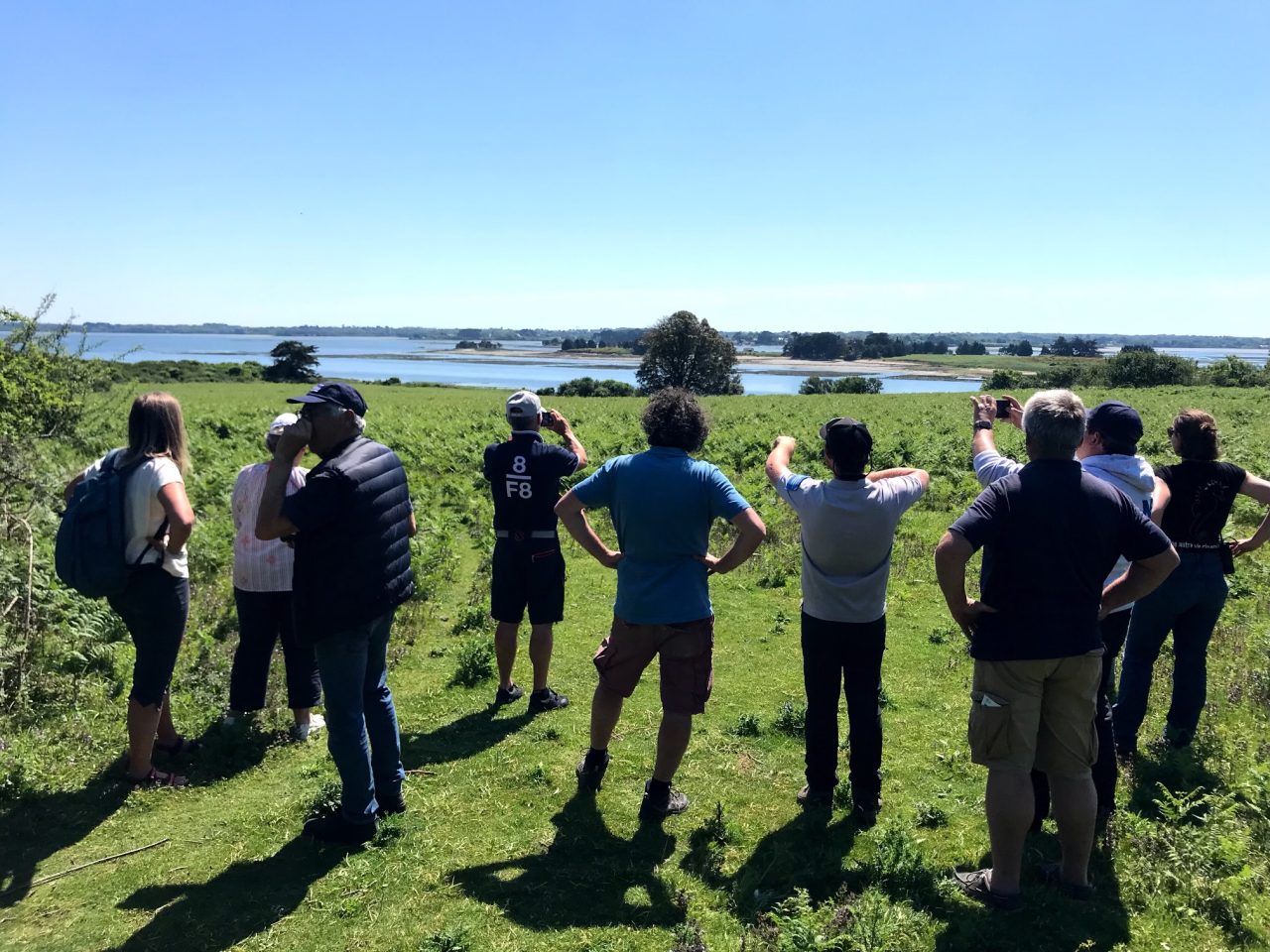
Very Practical SupportOn land, the focus is primarily on protecting bird populations: “For example, during concerts, there’s a decibel limit that must not be exceeded. We also ask that speakers not be pointed toward marshes or other areas where birds live,” explains Marine Pasquier, a Natura 2000 project manager for marine environments, who provides day-to-day support for Gulf of Morbihan Week.
At sea, the two main objectives are to protect eelgrass beds and gorgonian colonies: “There are 2,000 hectares of eelgrass beds out of the Gulf’s total 11,000 hectares. These underwater plants protect the Gulf’s biodiversity by providing habitat for numerous species (seahorses, small crustaceans, etc.), and cuttlefish reproduce there. They stabilize the seabed, sequester carbon… And certain birds feed on them as well. It is absolutely imperative that we protect them.
“Gorgonians are corals—few people know there are corals in the gulf. They’re mainly located at the entrance, where there’s a strong current. And the Grande Parade passes right in front of them...”
Prevention Isn’t Always EnoughDuring the event, temporary no-anchoring zones are established by prefectural decree, in addition to those designated year-round. “Together with government agencies and Gulf Week, we try to ensure that spectators don’t anchor in these protected areas.
Prevention isn’t always enough... But over the years, messages about environmental protection have been increasingly heeded,” emphasizes Ronan Pasco.
The Regional Nature Park live during Gulf Week!To learn more about all the Regional Nature Park’s initiatives, its teams invite you to visit them from May 5 to 9 at the Vannes Village booth, dedicated to the environment
_______________________________________
* Some DefinitionsA Natura 2000 site is a protected natural area at the European Union level. This status is designated to preserve habitats and animal or plant species that are rare, threatened, or of Community interest. Agriculture, fishing, hunting, cultural and sporting events, and tourism are permitted there, provided they respect the protected flora and fauna.
The Gulf of Morbihan Regional Nature Park acts as the Natura 2000 operator on behalf of the government.The 2 Natura 2000 sites in the Gulf of Morbihan
- The Special Area of Conservation (SAC) “Gulf of Morbihan, West Coast of Rhuys” under the Habitats Directive (approximately 20,609 hectares, 77% of which are marine areas).
- The Special Protection Area (SPA) “Gulf of Morbihan” under the Birds Directive (approximately 9,502 hectares, 91% of which are marine areas).
The warty gorgonian belongs to the coral family. It resembles a branched fan measuring 20 to 80 cm, and is white, yellow, or orange in color. The Gorets site, located west of Île Longue, is one of the most remarkable colonies of its kind in Europe.Eelgrass is a flowering plant found on sandy-muddy seabeds. Two species are present in the gulf: common eelgrass (permanently submerged) and dwarf eelgrass (in the intertidal zone, exposed at low tide).
They grow densely, forming refuge and breeding grounds for numerous species (seahorses, cuttlefish, sea bass, small crustaceans, etc.).
They also serve as a food source for certain bird species that winter in the Gulf, such as the Brent Goose.
Finally, they play a key role in sediment stabilization and CO₂ sequestration.
However, eelgrass is also sensitive to climate fluctuations, pollution, uprooting (from boat anchors), and trampling…
- Published on 21/10/2026